
Beginner's guide

Trading 101: What is Margin Trading? | EU Crypto Margin Guide
Beginner
2026-05-27 | 5m
As the European digital asset market matures under robust new regulatory frameworks, understanding advanced capital-efficiency strategies is a key consideration for modern investors. Whether you are transitioning from traditional equities or seeking a Regulated Crypto-Asset Service Provider (CASP) in the EU under the Markets in Crypto-Assets (MiCA) framework to scale your digital asset portfolio, mastering the fundamentals of leverage is a critical first step.
So, what exactly is this mechanism?
Margin trading is a financial strategy that allows investors to borrow capital from a broker or exchange to amplify their buying power, enabling them to open larger positions than their existing account balance would typically permit.
While this approach can significantly multiply potential profits, it also magnifies exposure to market volatility. Furthermore, with the implementation of comprehensive frameworks like MiCA (Markets in Crypto-Assets), engaging in margin trading in the EU now requires a strategic understanding of both market mechanics and regulatory compliance.
In this guide, we will explain the fundamentals of margin trading. We will explore how margin trading works, the different types of margin, and how Cross and Isolated margin modes work on Bitget EU.
1. What is Margin Trading?
Margin trading is a strategy where a trader borrows capital from a brokerage or exchange to increase their purchasing power, using their own underlying assets as collateral.
When operating on a Regulated Crypto-Asset Service Provider (CASP) in the EU under the Markets in Crypto-Assets (MiCA) framework, this framework also serves as a counterparty safeguard, ensuring that both sides of a contract fulfill their financial obligations under European regulatory standards.
2. How Does Margin Trading Work?
Starting a Margin Trade
To initiate a margin trade, you are required to
deposit a fractional amount of upfront equity, known as the
initial margin, into your account. This collateral allows you to borrow funds from the exchange, thereby increasing your market exposure beyond your actual cash balance.
This process is connected to leverage. For example, utilising 10x leverage means that an initial margin deposit of 1,000 USDC allows you to control a total position size of 10,000 USDC. While leverage can significantly increase potential gains, it also amplifies potential losses.
Maintaining Your Positions in Margin Trade
Engaging in margin trading requires regular risk management. Exchanges require traders to maintain a minimum account balance, known as the
maintenance margin, to keep open positions active.
If market volatility causes your account equity to drop below this required threshold, you will face a "margin call." At this point, you have three possibilities:
1. Inject Additional Capital: Deposit more funds into your margin account to restore the required equity levels.
2. Voluntarily Reduce Risk: Manually close loss-making positions to free up capital and meet the margin minimums.
3. Face Liquidation: If no action is taken, the exchange risk engine will automatically close your positions at market price.
3. Five Different Types of Margin
To navigate margin trading in the EU, traders should understand the terminology used by brokerages and exchanges to calculate risk and collateral. Below are the key margin types used in leveraged trading.
3.1 Initial Margin
Initial margin is the minimum amount of upfront collateral required to open a new leveraged position. It functions similarly to a down payment on a loan. On traditional exchanges, initial margin is typically set at 10% or less of the contract's notional value. On digital asset platforms, this requirement frequently varies to account for the higher daily price volatility of the cryptocurrency market.
3.2 Maintenance Margin
Maintenance margin is the minimum equity balance you must maintain in your account to keep an open position active. Positions are generally marked-to-market daily (or in real-time on crypto exchanges), meaning your account balance fluctuates with asset prices.
If market movements push your equity below this maintenance threshold, the exchange will issue a margin call. At this point, you must deposit additional collateral to restore your equity back to the initial margin level, or you will face forced liquidation. Maintenance margin requirements are mathematically designed to always be lower than initial margin requirements.
3.3 Variation Margin
Variation margin represents the exact amount of additional capital required to satisfy a margin call. It is the mathematical difference between your current depleted account balance and the required initial margin. This figure is calculated dynamically on a position-by-position basis.
3.4 Available Margin
This refers to the total liquid equity accessible for deploying new trades at any given time. Bitget EU offers a structural advantage through advanced margining offsets: if you open two opposing positions on the same underlying asset and settlement currency, collateral is only required for the larger position.
Example: If you hold a long position of 5 BTC and a short position of 2 BTC (both settled in USDC), margin is only levied on the net 5 BTC long. This efficient design optimises capital utilisation for complex hedging strategies.
3.5 Risk Margin
Risk margin is a dynamic, real-time collateral requirement based on the aggregate risk profile of your entire account. Rather than evaluating positions in isolation, this mechanism accounts for active hedging strategies and updates instantaneously as market prices and contract values fluctuate. Bitget EU uses this advanced framework to minimise unnecessary liquidation risks, providing a more compliant environment for professional margin trading in Europe.
4. Cross Margin vs. Isolated Margin: Strategic Capital Allocation
When engaging in margin trading, structuring how your collateral is distributed is just as critical as the trades you execute. There are two primary margining models, Isolated and Cross, each suited to distinct trading strategies and risk tolerances.
Regulated Crypto-Asset Service Providers (CASPs) in the EU under the Markets in Crypto-Assets (MiCA) framework, such as Bitget EU, support both models, allowing traders to choose between them based on their trading approach.
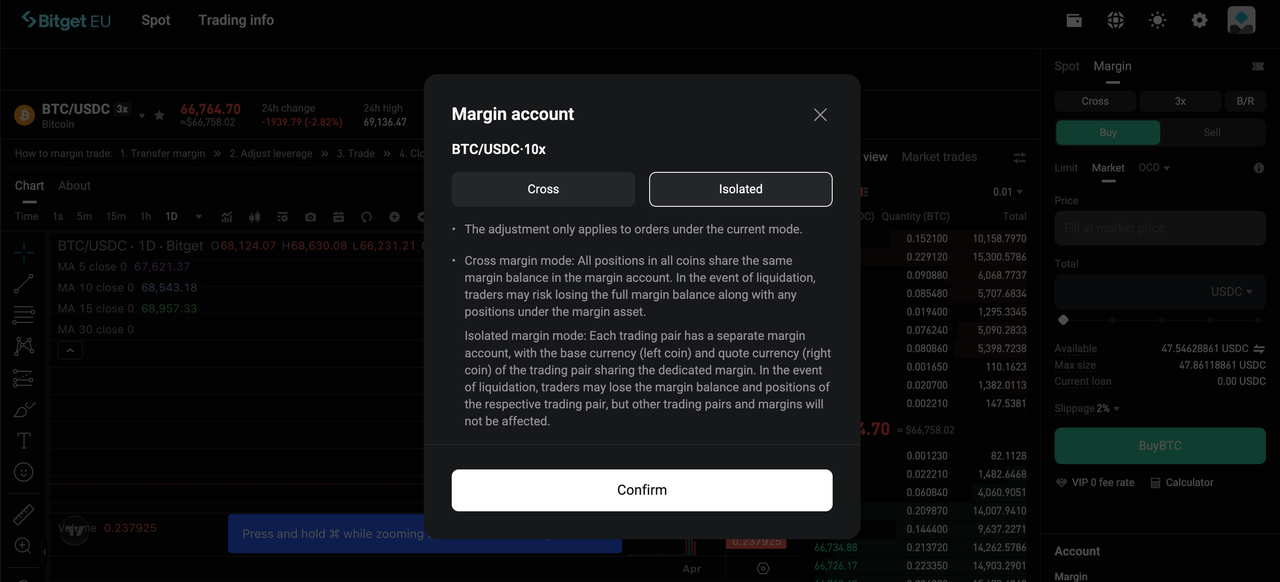
4.1 Isolated Margin
In this model, a fixed amount of margin is allocated to an individual position. The initial collateral for each trade is separated from the rest of your account equity.
-
Advantage: By isolating your collateral, your maximum potential loss is capped at the margin allocated to that specific position. If the market moves against you and triggers a liquidation, the event is contained; your remaining portfolio and available account balance remain unaffected.
-
Trade-off: Because collateral is restricted, these positions may be more sensitive to price movements. Isolated Margin requires regular portfolio monitoring to maintain appropriate maintenance levels.
4.2 Cross Margin
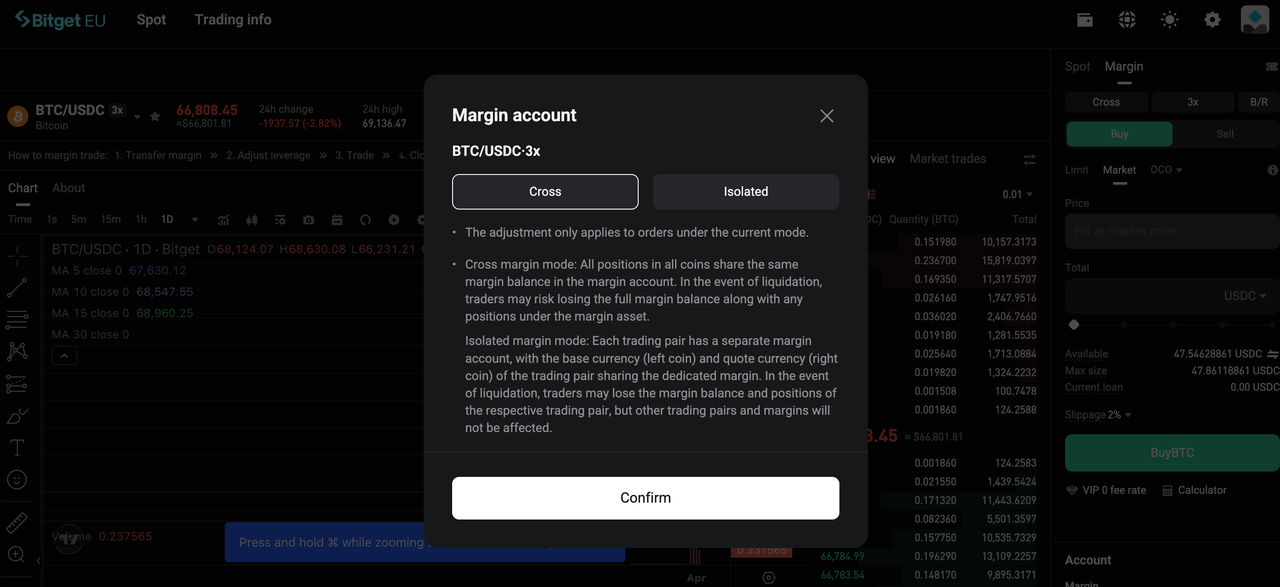
In this model, all available equity within your account is pooled to serve as joint collateral for every open position.
-
Advantage: This model is suited for longer-term strategies and hedging. By using your total account balance as a cushion, unrealised profits from winning positions can offset the margin requirements of losing positions, potentially reducing the likelihood of sudden liquidations.
-
Trade-off: While Cross Margin offers flexibility against minor price fluctuations, it introduces account-level risk. A significant loss on a single leveraged position may reduce the shared collateral pool, potentially affecting your entire account balance. This approach requires consistent macro-level risk management.
5. Bitget EU Margin Calculator
Before committing capital to a leveraged position, using quantitative tools to simulate trade scenarios can help with risk assessment.
The
Bitget EU Margin Calculator is a pre-trade modeling tool designed to help calculate potential profits, target exit prices, and liquidation thresholds. Built into the spot margin trading interface, it allows users on Bitget EU, a Regulated Crypto-Asset Service Provider (CASP) in the EU under the Markets in Crypto-Assets (MiCA) framework, to plan their capital deployment.
Before entering a position, the Bitget EU margin calculator lets you model the trade without committing any capital. It is accessible via the
[Calculator] button at the bottom right of the trading panel.
How to Access the Calculator
On the Bitget EU spot margin trading dashboard, locate the
[Calculator] icon in the bottom right corner of the order entry panel. Clicking it will open the margin calculation interface.
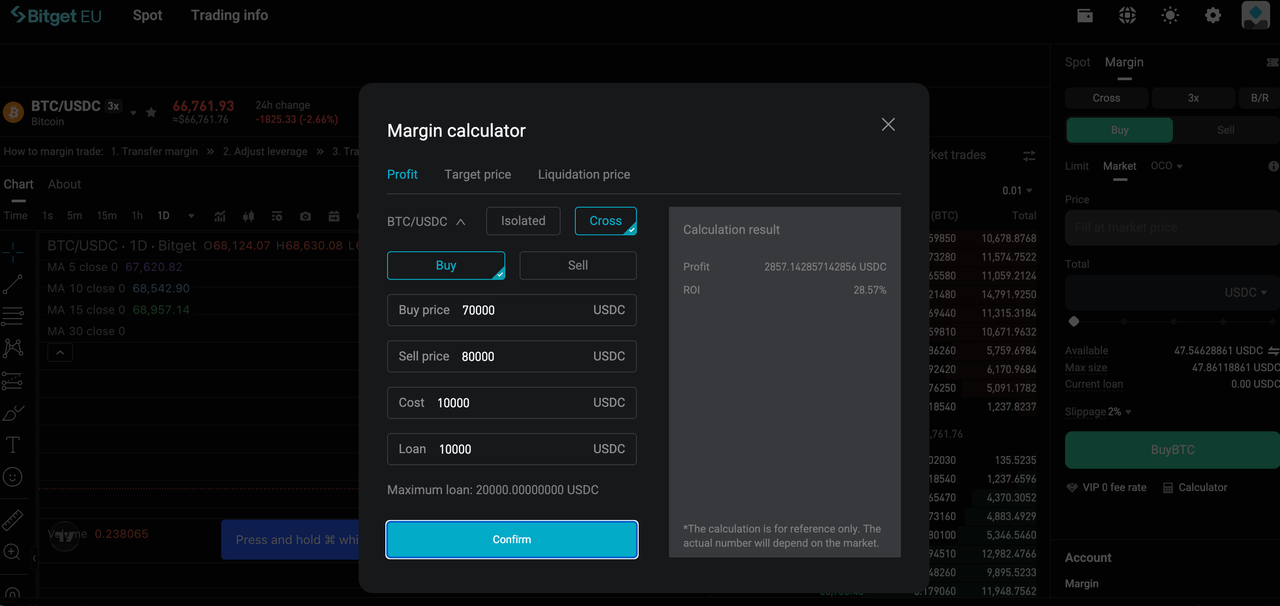
Before inputting data, you can toggle between Isolated and Cross margin modes and select your specific trading pair (e.g., BTC/USDC). This allows the outputs to reflect the margin model you intend to use.
Core Features: The Three Calculation Tabs
The calculator is divided into three modules, each serving a different function:
1. The Profit Tab
This tab estimates your profit and Return on Investment (ROI) based on your anticipated entry and exit parameters
-
Buy Price: Your projected entry price for the asset (in USDC).
-
Sell Price: Your target exit price (in USDC).
-
Cost: Your actual equity (initial margin) committed to the trade.
-
Loan: The amount of capital you are borrowing from the exchange. (Note: The system dynamically displays your maximum borrowing limit based on the asset pair and selected margin mode).
Upon clicking
[Confirm], the tool calculates your projected
Profit (net gain in USDC) and
ROI (percentage return on your initial cost).
2. The Target Price Tab
If your trading strategy includes a profit or ROI target, this tab calculates the exit price required. By inputting your buy price, equity cost, loan amount, and desired ROI, the calculator provides an estimated sell price.
3. The Liquidation Price Tab
When using leverage, understanding your risk threshold is important. By inputting your buy price, initial cost, and loan amount, this tab provides an estimated liquidation price, the market level at which the exchange's risk engine would close your position. This can help with setting stop-loss orders.
When to Use the Calculator
The margin calculator is intended for pre-trade planning. It can be useful when:
-
Projecting Yields: You want to estimate potential ROI before committing capital.
-
Optimising Leverage: You are deciding how much capital to borrow, allowing you to see how varying loan sizes impact both returns and liquidation risk.
-
Setting Stop-Losses: You want to compare your estimated liquidation price against technical support and resistance levels.
-
Comparing Margining Models: You want to compare how an identical trade performs under Isolated versus Cross margin.
| Important Risk Disclaimer: Margin trading carries a high level of risk. Leverage can amplify both gains and losses. All calculator outputs are theoretical estimates provided for reference only. Actual trade outcomes are subject to live market conditions and may differ materially. The calculator does not account for daily borrowing interest, platform trading fees, or execution slippage. |
Margin trading on Bitget EU gives you access to leverage, EU-compliant risk controls, and tools like the margin calculator to plan trades before you place them. Understanding how margin works and using the tools available can help you manage risk when trading on margin.
Conclusion
Engaging in margin trading in the EU requires more than market intuition; it requires understanding the platform's infrastructure. By using Bitget EU, a Regulated Crypto-Asset Service Provider (CASP) in the EU under the Markets in Crypto-Assets (MiCA) framework, investors gain access to leverage, regulatory-aligned risk controls, and quantitative tools such as the margin calculator to model trades prior to execution.
A solid understanding of margin mechanics, combined with the use of pre-trade risk management tools, can help traders manage their exposure. As the European digital asset landscape continues to mature, trading on a transparent, regulated platform provides a framework for leveraged participation.
Disclaimer
:
Margin trading carries a high level of risk and may not be suitable for all investors. The high degree of leverage can work against you as well as for you. Before deciding to trade on margin, you should carefully consider your investment objectives, level of experience, and risk appetite.
The opinions expressed in this article are for informational purposes only. This article does not constitute an endorsement of any of the products and services discussed or investment, financial, or trading advice. Qualified professionals should be consulted prior to making financial decisions.
Share


Content
- 1. What is Margin Trading?
- 2. How Does Margin Trading Work?
- 3. Five Different Types of Margin
- 4. Cross Margin vs. Isolated Margin: Strategic Capital Allocation
- 5. Bitget EU Margin Calculator
- Conclusion
Recommended
 The Uncensored Guide on How to Spot Trade on Bitget EU2026-05-22 | 5m
 Bitget EU VIP Premier Wealth Hub Introduction2026-05-25 | 5m
 How to Buy Crypto With a Credit/Debit Card on Bitget EU2026-05-22 | 5m
Up to 6200 USDC and LALIGA merch await new users!
Claim