
Beginner's guide

Trading 101: What is Spot Trading
Beginner
2026-05-11 | 10m
Spot trading is the simplest way to own cryptocurrency: you buy, you hold, you sell. No leverage, no expiry, no margin calls — just the asset and its market price. For European traders, the question isn't just "how does it work" but "where and how should I do it under MiCA." This guide covers both.
What is Spot Trading?
Spot trading is the process of buying or selling a financial asset—in this context, a cryptocurrency—at its current market price, with the transaction settled immediately or within a very short timeframe. The term
"spot" refers precisely to this immediacy: you are trading
on the spot, exchanging one asset for another at the prevailing market rate the moment the order is executed.
When you engage in spot trading, you acquire direct ownership of the underlying asset. Buy Bitcoin on a spot market, and that Bitcoin is credited to your exchange account, where it is held in custody by the platform. While the asset remains accessible within your account for trading, transferring, or withdrawing, it is important to understand that custodial holdings on a centralised exchange are subject to the platform's operational infrastructure, security protocols, and terms of service. For full self-custody, you may withdraw your holdings to an external, non-custodial wallet at any time.
How It Works
Spot trading is straightforward in concept, yet supported by market infrastructure beneath the surface. Here is how the process unfolds on the platform:
1. The Order Book
Every spot market operates through an order book — a ledger that records all active buy orders (bids) and sell orders (asks) for a given trading pair. When you place an order to buy Ether (ETH) with USDC, for example, the exchange's matching engine scans the order book to pair your bid with a corresponding request from another market participant.
2. Trading Pairs
Spot trading always involves a trading pair — two assets being exchanged simultaneously. Common examples include:
-
BTC/ USD C: Bitcoin bought or sold in exchange for USDC
-
ETH/EUR: Ether traded directly against the Euro
-
SOL/BTC: Solana exchanged for Bitcoin
The first asset in the pair is the base currency (what you are buying or selling), while the second is the quote currency (what you are using to purchase it or what you receive upon selling).
3. Order Types
Spot trading platforms offer multiple order types, each serving a different purpose:
-
Market Order: Executes immediately at the best available current price. Suited for speed, though it offers less price control.
-
Limit Order: Sets a specific price at which you are willing to buy or sell. The order executes only when the market reaches your defined price.
-
Stop-Limit Order: Combines a trigger price with a limit price, allowing for defined entry and exit conditions.
4. Settlement
Unlike more mainstream financial markets where settlement can take two business days (T+2), crypto spot trades settle near-instantly. Once matched, the assets are transferred between accounts in real time.
What Assets Can You Spot Trade?
On a platform like Bitget EU under MiCA, the assets available for spot trading typically include:
-
Major Cryptocurrencies: Bitcoin (BTC), Ether (ETH), and other large-cap assets
-
Altcoins: A selection of mid and small-cap tokens
-
Stablecoins: Fiat-pegged digital assets like USDC and EURC, commonly used as the quote currency in spot pairs
-
Tokenised Assets: Real-world assets digitally represented on a blockchain, available on some EU platforms
The range of available pairs and liquidity across them is one factor to consider when choosing a platform. Major spot markets operate 24/7 with liquidity across trading pairs.
Why Spot Trading Matters in the EU
Understanding the mechanics is only part of the picture. For European investors, the regulatory context matters equally.
Under MiCA, spot trading on a regulated exchange comes with defined rules around custody, transparency, and consumer protection. What that means in practice:
-
Your assets are held under custody and segregation standards
-
The platform operates under a legal framework enforceable across EU member states
-
Fee structures, dispute processes, and anti-manipulation protocols are transparent
-
Your data is handled under GDPR and AML directives
Trading outside a comparable regulatory framework carries counterparty risk and may offer limited legal recourse in the event of platform failure.
Spot Trading vs. Margin Trading
Both involve buying actual crypto on the same order books. The difference: in spot, you use your own money — €1,000 buys €1,000 worth of BTC. In margin, you borrow to amplify your position — €1,000 at 3x gives you €3,000 exposure. That amplifies gains, but losses can also exceed your deposit. Margin trades can be liquidated if the market moves against you.
To learn more about Margin Trading, read
Trading 101: What is Margin Trading? | EU Crypto Margin Guide
.
Where to Trade
Centralised Exchanges (CEXs)
Intermediaries matching buyers and sellers via order books. In the EU, this includes regulated platforms under MiCA (e.g. Bitget EU, supervised by FMA). They offer liquidity, fiat on-ramps (including SEPA), trading tools, and legal transparency under a defined framework.
Decentralised Exchanges (DEXs)
Decentralised exchanges operate without a central intermediary. They rely on smart contracts and Automated liquidity makers (often known as AMMs) deployed on blockchains like Ethereum or Solana to facilitate direct asset swaps between users. Users retain self-custody but generally lack fiat support, require technical familiarity, and operate outside regulated frameworks.
Crypto Brokers and Neobanks
Many fintech apps, neobanks, and digital brokerages offer crypto purchasing options alongside traditional financial services.
Convenient for beginners, but often restrict withdrawals to external wallets and charge wider spreads, with fewer order types and charting tools than dedicated trading platforms.
How to Start Spot Trading on Bitget EU
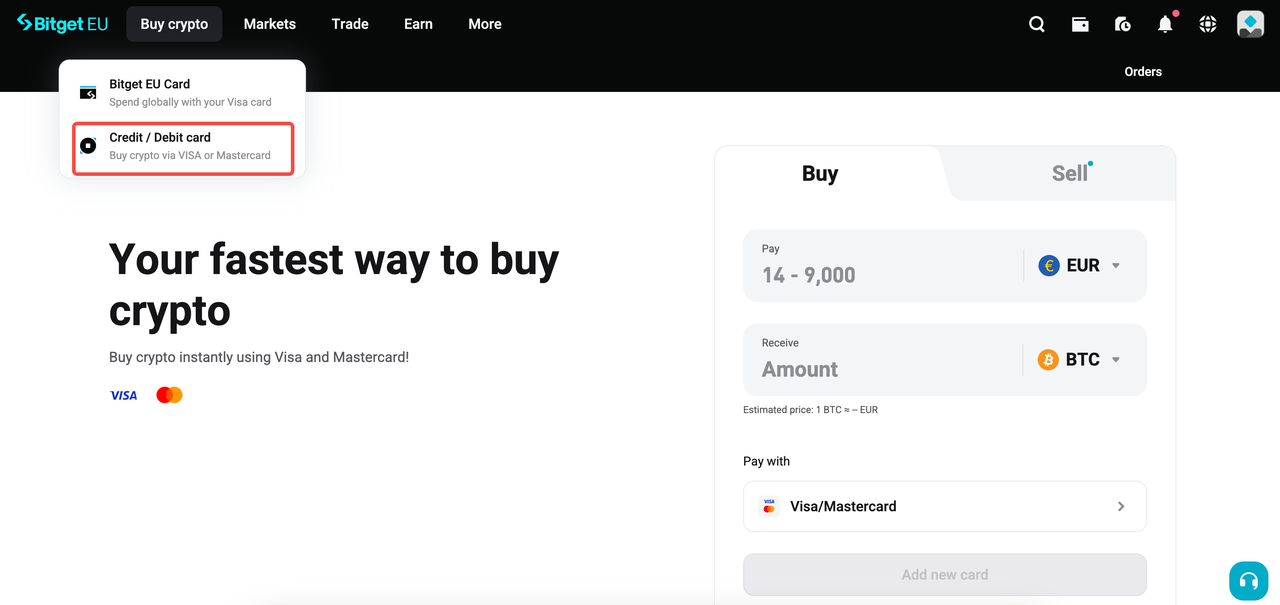
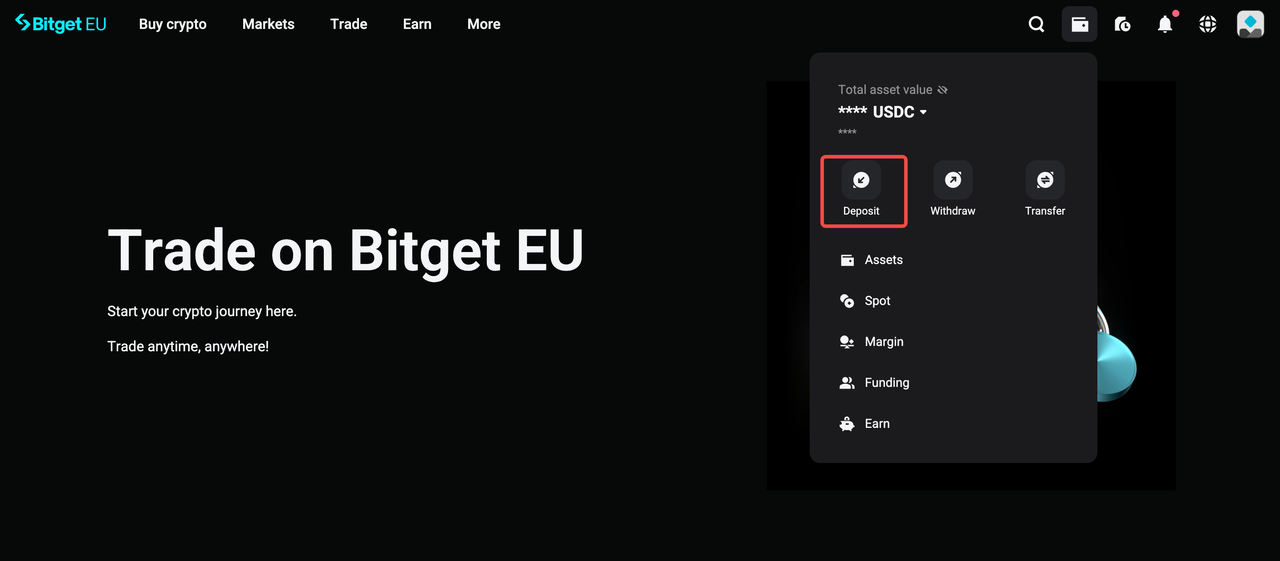
Step 1: Fund Your Account
To begin, log in to your
Bitget EU account. You have two options:
-
Direct Fiat On-Ramp: Purchase foundational assets like USDC, BTC, or ETH using a credit or debit card.
-
Crypto Deposit: Transfer existing cryptocurrency from an external wallet directly into your Bitget EU Spot account.
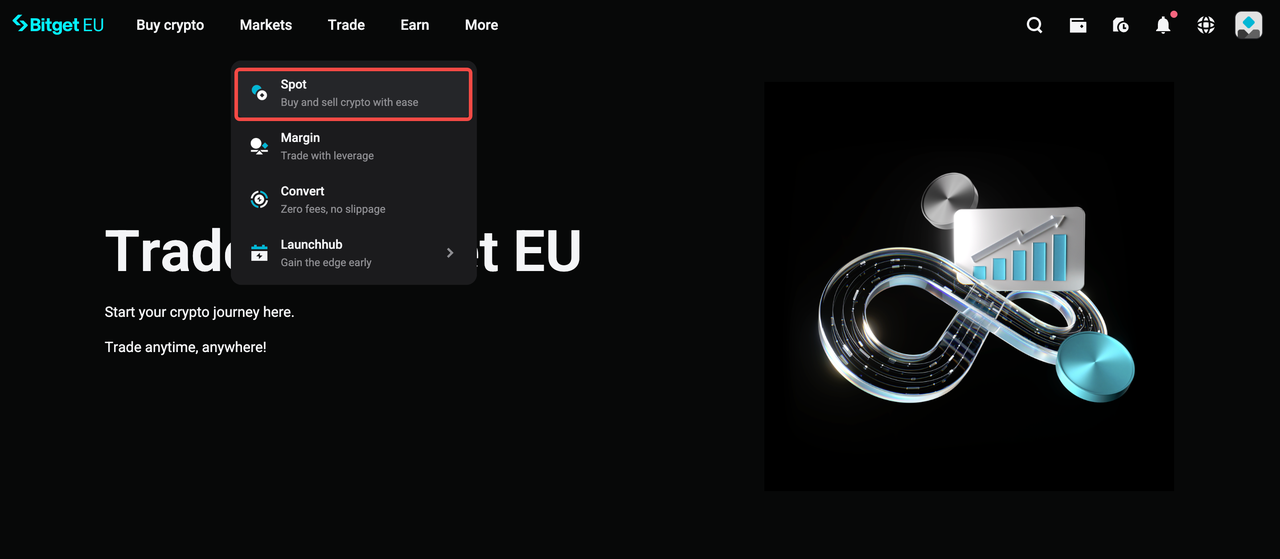
Step 2: Go to the Spot Trading Page
Once your account is funded, go to the
Spot Trading page, or hover over
Trade and choose
Spot in the dropdown menu.
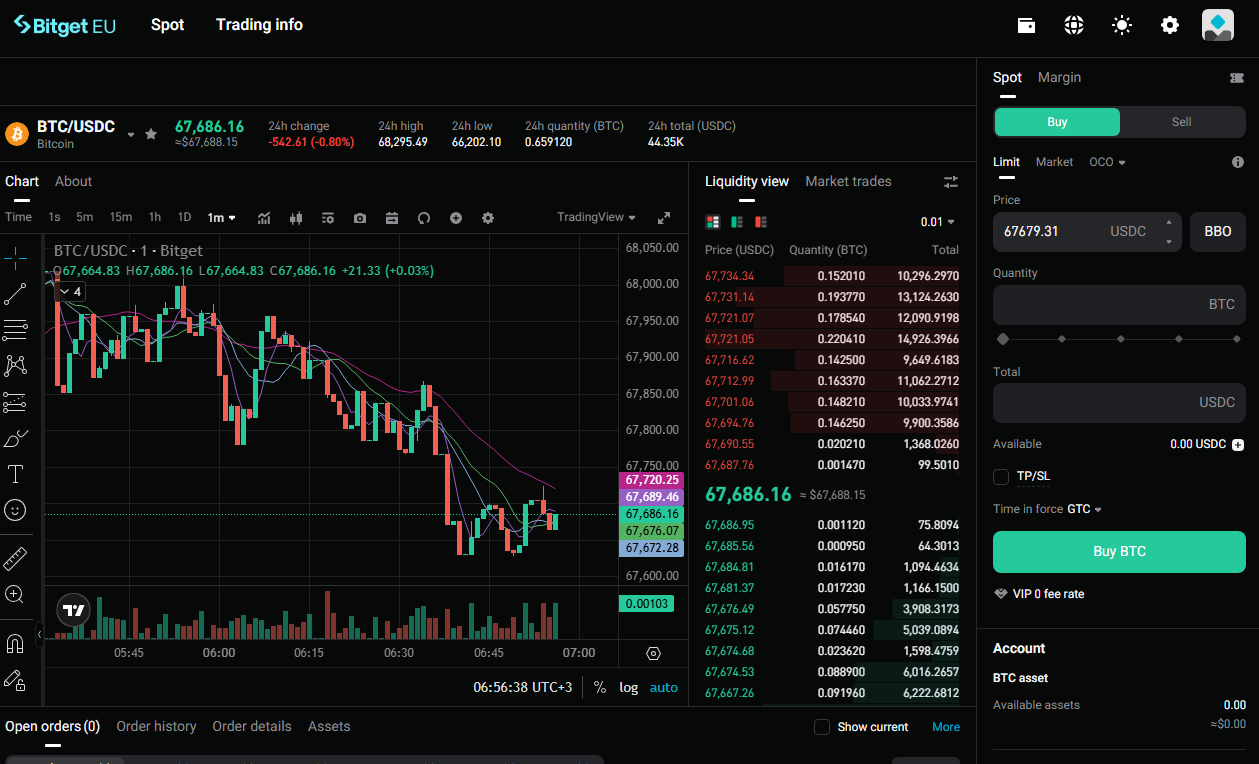
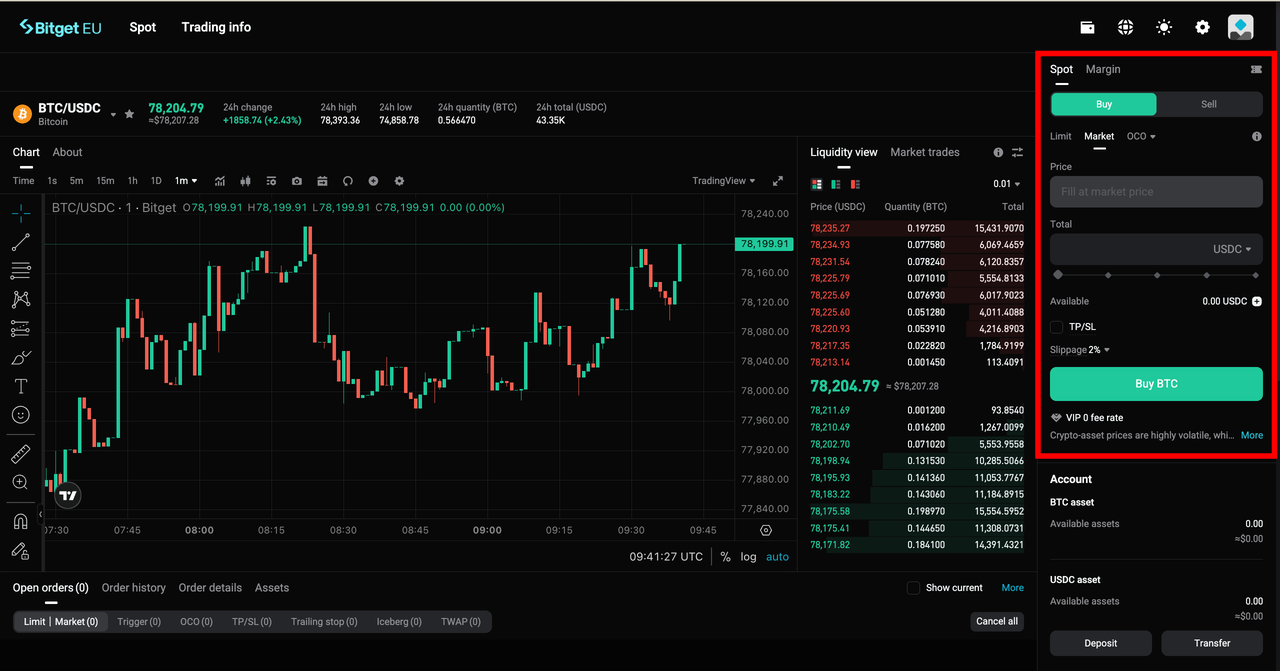
The trading interface includes:
-
Real-Time Order Books: Monitor market depth and live liquidity.
-
Charting Tools: Use integrated TradingView tools and indicators for technical analysis.
Step 3: Place Your Order
Select your preferred trading pair (for example, BTC/USDC), choose your order type, enter the volume you wish to trade, and click
Buy or
Sell. Bitget EU offers the following order types:
-
Market Orders: Execute immediately at the best available current price.
-
Limit Orders: Set a specific price at which you wish to buy or sell, allowing for defined entry and exit points.
-
Trigger Orders: Set conditional orders that execute when the market reaches a specified price threshold.
-
OCO (One-Cancels-the-Other): Combine a take-profit and stop-loss order in one strategy; when one executes, the other is automatically cancelled.
-
TP/SL (Take Profit / Stop Loss): Set predefined exit prices for an open position to manage risk or lock in gains.
Step 4: Check Your Assets
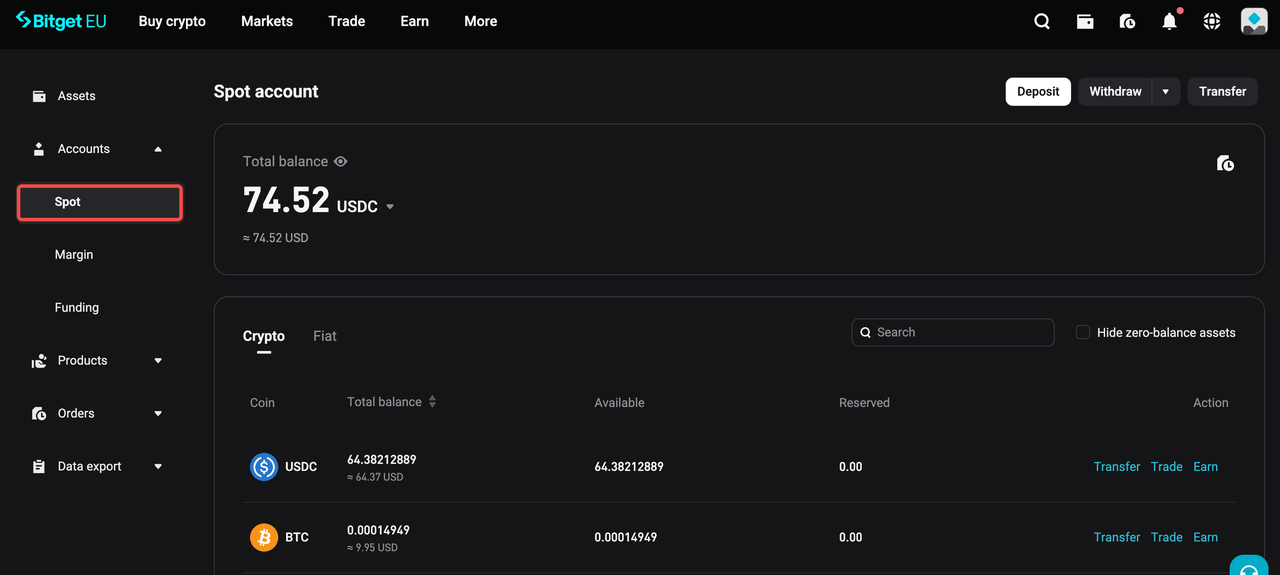
Once your order is filled, the assets are credited to your account. Navigate to
Assets →
Spot to view your holdings.
Create your Bitget EU account today
to get started.
The opinions expressed in this article are for informational purposes only. This article does not constitute an endorsement of any of the products and services discussed or investment, financial, or trading advice. Qualified professionals should be consulted prior to making financial decisions.
Share


Content
- What is Spot Trading?
- How to Start Spot Trading on Bitget EU
Recommended
 The Uncensored Guide on How to Spot Trade on Bitget EU2026-05-22 | 5m
 Bitget EU VIP Premier Wealth Hub Introduction2026-05-25 | 5m
 How to Buy Crypto With a Credit/Debit Card on Bitget EU2026-05-22 | 5m
Up to 6200 USDC and LALIGA merch await new users!
Claim